
Smooth Ceiling Finish After Popcorn Removal
Taking off the popcorn is only half the job. We skim coat, sand and prime the bare drywall so your ceiling comes out flat, even and ready for paint.
Get a Free QuoteWhy a bare ceiling rarely looks smooth
Popcorn texture was often sprayed over drywall that was only taped and coated to a basic level, because the texture would hide the rest.
Once the texture is scraped off, everything it was covering shows up: tape seams, screw and nail dimples, joint compound ridges, small gouges from scraping, and stubborn patches of leftover texture. Paint does not hide any of that. In fact, a fresh coat of flat white can make seams and dents more noticeable, especially in rooms with big windows or sliding doors where light hits the ceiling at a low angle.
That is why most homeowners who want the clean, modern look of a smooth ceiling need more than removal. They need the drywall surface rebuilt into one even plane. In the trade that work is called skim coating, and the target standard is often called a Level 5 finish.
Test first, always. Before we scrape any popcorn ceiling, we coordinate professional asbestos testing. Smooth finishing starts only after a negative result, or after a licensed abatement contractor has finished a ceiling that tested positive.
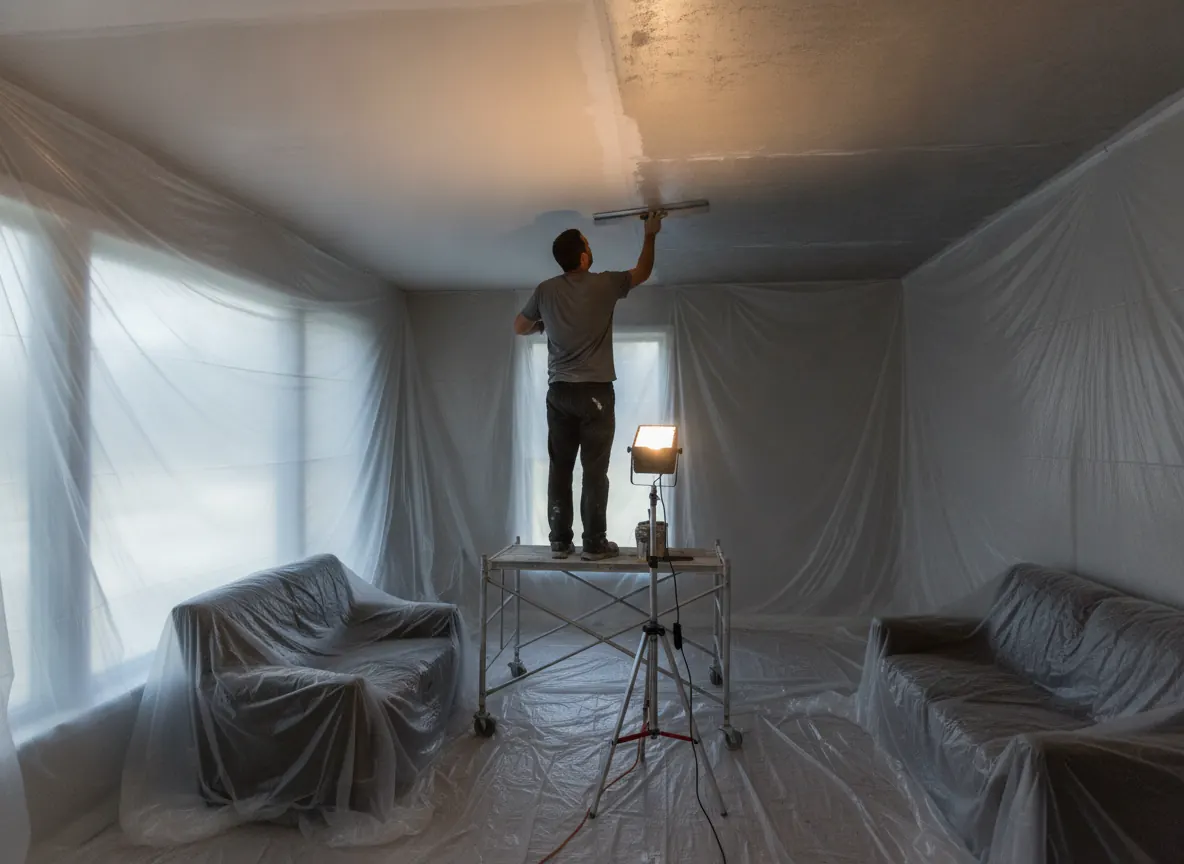
Skim coat and Level 5, explained
Drywall finishes are described in levels. The lower levels cover taping joints and coating fasteners. Level 5, the top level, adds a thin skim coat of joint compound over the whole surface, so the drywall paper and the patched areas end up with one consistent texture and absorb paint the same way.
For a ceiling coming out of popcorn, skim coating does three jobs at once:
- Fills scraping marks, dents and fastener pops
- Buries tape seams so they don’t show through paint
- Evens out the surface so light reads it as one flat plane
Not every ceiling needs a full Level 5. Some need targeted repairs and a skim over only the worst areas. We look at the bare ceiling and recommend what it actually needs, rather than defaulting to the most work.
How we get from scraped to smooth
Inspect and repair
After removal we check for loose tape, cracked seams, popped fasteners and any water-damaged drywall. Problem spots get fixed first, because skim coating over a bad repair just hides it for a while.
Skim coat
Thin coats of joint compound go on with wide knives or rollers and trowels. Thin coats dry more evenly and sand more cleanly than one heavy coat.
Sand with dust control
Each coat is sanded once dry. The room stays sealed in plastic from the removal stage, and we keep dust contained and cleaned up as we go.
Inspect with a light
We check the ceiling with a raking light to catch ridges and low spots before primer, when they are still easy to fix.
Prime
A drywall primer seals the compound so the finish paint goes on evenly and the ceiling doesn’t look blotchy.
See how this fits into the whole job on our process page.
Sanding, primer and drying time in Gainesville
Joint compound needs time to dry between coats, and humidity affects that. Gainesville’s humidity runs high from about mid-May through September, with frequent afternoon thunderstorms. We plan coats around conditions in your home and keep the air conditioning running where we can, so we’re not sanding compound that is still soft.
Primer is not optional on a skim-coated ceiling. Fresh compound is very porous; skip primer and the finish coat soaks in unevenly, leaving flashing and patchy sheen. After priming, the ceiling is ready for ceiling painting in a flat ceiling white or the color of your choice.
Still deciding between smooth and textured? Our comparison of smooth vs knockdown vs orange peel lays out the look, cost and upkeep of each, and our knockdown and orange-peel page explains when texture is the smarter call.
Smooth finish pricing
National cost guides put a skim coat at about $1–$1.50 per square foot, added to removal at roughly $1–$4 per square foot for a ceiling that tested negative. Painting adds about $1–$3 per square foot. These are typical ranges; the full table, a room-by-room breakdown and a calculator are on our cost guide. For an actual number, get a free quote and we will look at your ceilings in person.
Smooth ceiling FAQ
What is a Level 5 drywall finish?
Level 5 is the highest standard drywall finish. After the joints and fasteners are taped and coated, a thin skim coat of joint compound goes over the entire surface so the paper and the mud dry to one even texture. It is the finish to choose when a ceiling is lit by low-angle light from windows, sliders or a lanai.
Do I need a skim coat after popcorn removal?
Usually, if you want a truly smooth ceiling. Scraping leaves behind tape lines, fastener dimples, nicks and leftover texture that show through paint. Some ceilings in good shape need only spot repairs, but most need at least partial skim coating. We look at the bare ceiling with you and recommend the least work that gets a clean result.
How much does a smooth ceiling finish cost?
National cost guides put a skim coat at roughly $1–$1.50 per square foot, on top of removal at about $1–$4 per square foot for a ceiling that tested negative. Painting after removal adds about $1–$3 per square foot. These are typical ranges, not a quote; your price comes from an in-home look.
How long does a smooth finish take after removal?
Skim coating is done in thin coats, and each coat has to dry before sanding and the next coat. Gainesville’s humid months from about mid-May through September can slow drying, so we plan the schedule around conditions in your home. We give you a realistic timeline during the free quote.
Is a smooth ceiling better than knockdown?
Not always. Smooth ceilings look clean and modern but show every flaw, so they need more prep. Knockdown or orange-peel texture hides minor imperfections and usually costs less. If the drywall underneath is rough, retexture can be the more practical choice. We will tell you honestly which suits your ceiling.
Ready for smooth, modern ceilings?
Free, no-pressure quotes across Gainesville, Alachua, Newberry, High Springs and the rest of Alachua County.